This is the end of the U.S. global monetary system
Steve Keen

The US-dollar-based international monetary system will not survive this Presidency.
There is, of course, just one man who is to blame for our current predicament. And that man is Harry Dexter White.
If you’re saying “Harry Who?” to yourself right now, White was the head of the U.S. delegation to the Bretton Woods Conference, which crafted the Post-War international financial system.
It is because of him that the US dollar became the currency for international trade. It is because of the consequences of that system for working class Americans that Donald Trump became President.
Since the US dollar is used for almost all international transactions, and because the US is – or was – the strongest economy on the planet, the US dollar is significantly overvalued. That makes American manufacturing uncompetitive. This and several related factors have eliminated the skilled blue-collar jobs that were once the backbone of the political support for the Democrats. As manufacturing declined, the financial sector rose, because the overvalued dollar empowered the financial sector. The Democrats fell for the specious argument that manufacturing was passe, and that services were the future for America, while manufacturing jobs could be off-shored to low wage Asian countries. They morphed from the representatives of the working class into the representatives of the financier class.
This was all couched in the language of specialisation and efficiency, but the reality for Americans workers was the collapse of skilled employment. The manufacturing heartland of America became “The Rust Belt”, leaving its once working class confused, and justifiably angry. They shifted from seeing the Democrats as their protectors to what they had become, the representative of their enemies.
This disaffected and discarded class was easy prey to a Republican Party taking an anti-government line. Trump has been the most ruthless exploiter of this sense of betrayal felt by much of the US population.
Therefore, Harry Dexter White set the grounds for Trump’s electoral success. Trump himself was not inevitable, but the breakdown of the system that gave rise to him was. Trump is simply accelerating the process by his narcissistic overreach.
The fundamental flaw of the current system is what I describe as the Curse of Capitalist Empires: any country that creates an Empire in a capitalist world system is undermined when its currency becomes the basis of international trade.
The process is as follows:
No country has ever become an empire by conquering other countries with imported weapons. A critical step in becoming an empire, therefore, is the creation of weapons that defeat its rivals. This requires a strong manufacturing sector;
Once that country becomes an empire, its currency becomes the basis of international trade within its empire;
This pushes up the value of its currency relative to its vassals, which weakens the empire’s manufacturing sector;
One (or more) of the empire’s vassals (or rivals) develops a strong manufacturing sector, which enables it to construct weapons that enable it to overthrow the empire;
That once vassal becomes the next empire, its currency replaces that of the previous empire as the currency for international trade, and the cycle repeats.
Becoming the international currency is therefore not so much a spoil of empire, as a spoiler of empires. It is a poisoned chalice out of which the foolish drink, convinced that their temporary ascendancy is eternal. It is not the only reason, but surely is one of the most significant reasons, that the Spanish empire lost out to the Dutch, the Dutch to the British, and, at the time of Bretton Woods, the British to the American. We are now witnessing the American losing out to the Chinese.
The only way to stop this cycle is to use a unit of account for international trade which is not a national currency. Such a proposal was made at Bretton Woods (Steil 2013; Keynes 1943), but it lost out to White’s imperial insistence that the American Dollar must replace the British Pound as the currency for international trade.
If any good can come out of the crazy situation we are in now – with NATO members wondering how to prevent the invasion of a NATO country by another NATO country – it would be that an updated version of that proposal is revived as the basis of a postTrump international economic order.
The core idea is that a unit of account – and not a currency – is used as the means of international exchange. The unit of account would be administered by an International Clearing Union (ICU) at which all national central banks have accounts, and the sum of all these accounts would start at and remain at zero. A country which has a trade or payments surplus with the rest of the world would accumulate a positive balance; a country with a trade or payment deficit would run up an overdraft.
This system would end the Curse of Capitalist Empires, by ending the otherwise automatic overvaluation of the empire’s currency. Figure 1 shows the overall structure of the system, with USA and China used for illustration.
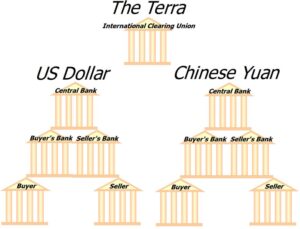
National currencies would be used for intra-national trade, as now. These would have to be converted into the international unit of account — which I propose we call the “Terra”, to remind ourselves that we all share the same planet — to buy goods (and services) produced in another country.
The exchange rate between the Terra and national currencies would be set on the basis of the relative exchange rates applying between national currencies when the system was created. The rate would vary over time, based on persistent trends in each country’s balance of trade. A country with a persistent surplus would have its currency appreciate against the Terra, so that it would cost more in Terra to purchase its goods; a country with a persistent deficit would have its currency depreciated, making it cheaper to purchase its goods. This could be done by a system within the ICU, or by a market-determined system — though there would be far less trading of national currencies in this system than we are obliged to endure today.
To discourage both large surpluses and large deficits, a progressive penalty rate of interest would be charged on both positive (surplus) and negative (deficit) balances above a predetermined threshold, of say 2 percent of a country’s GDP.
The interest charge would then be transferred to underdeveloped nations, replacing international aid. Since Terras can only be used to buy goods from other countries, this would enable underdeveloped nations to buy inputs they need for development from more advanced countries.
This proposal is a slightly modified version of the system Keynes proposed at Bretton Woods (Keynes 1943). Keynes had hoped that the goodwill of Allied governments, after the horrors of the Great Depression and World War II, would lead them to accepting a system with a truly multilateral world order, rather than one dominated by the empire of its day. Instead, he lost the argument to the shortsighted arrogance of the American delegation.
Could this system come about now? The argument against it since the end of WWII has always been that, with post-war goodwill long gone, countries would not be willing to cooperate in building a system that constrained all of them. That was the reality until the appearance of Trump. Now, the rest of the world could develop this system in order to get away from Trump’s ill will.
The speech of Mark Carny (Canadian PM) at Davos is the first inkling that such a reasoned revolt might actually be possible. Personally, I expect that it will take yet more outrages by The Peace President before there will be global agreement to end the system that gave birth to him.
References
Keynes, J. M. 1943. ‘Proposals For An International Clearing Union (April 1943).’ in Naomi Lamoreaux and Ian Shapiro (eds.), Bretton Woods Agreements: Together with Scholarly Commentaries and Essential Historical Documents (Yale University Press: Yale).
Steil, Benn. 2013. The Battle of Bretton Woods: John Maynard Keynes, Harry Dexter White, and the Making of a New World Order (Princeton University Press).
Source:
Building a New Economics, 21 Jan 2026 https://[email protected]
The article is republished with the permission of the author. If you like Steve’s economic analysis then you are invited to support his work by signing up to either of the following networks:
(a) Patreon (https://www.patreon.com/ProfSteveKeen – minimum $10 per year);
(b) Substack (https://profstevekeen.substack.com/ — minimum $5 per month).
Also, readers might like to consider applying for Steve Keen’s 7-week online teaching course: “Rebel Economist Challenge”.
Every week on live Mastermind Sessions, via https://www.stevekeen.com And as an additional bonus, those who qualify may download some of Steve’s books for free.