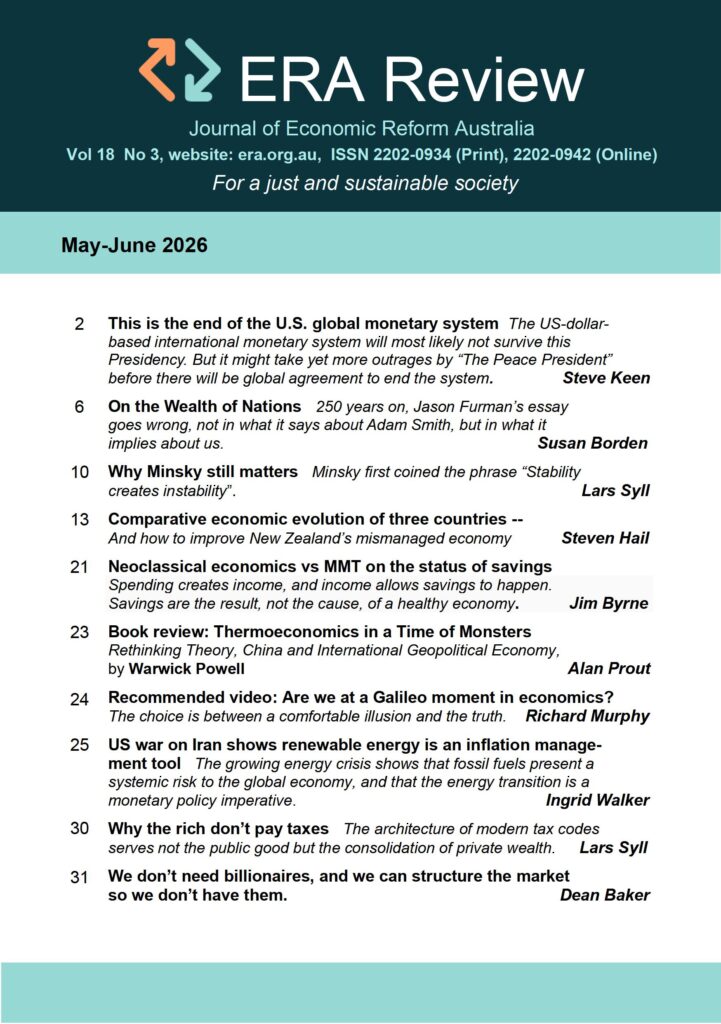
On The Wealth of Nations
Susan Borden
250 years on, Jason Furman’s essay goes wrong, not in what it says about Adam Smith, but in what it implies about us….
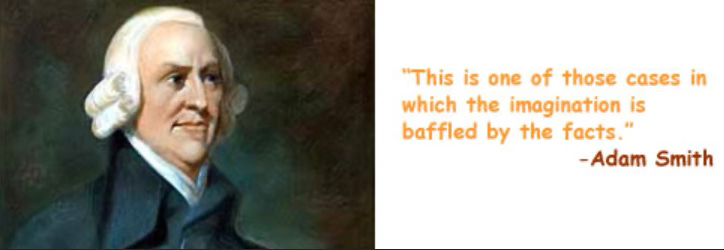
To celebrate the 250th anniversary of Adam Smith’s The Wealth of Nations, a Harvard economist, Jason Furman, writing in the New York Times, correctly suggests that Smith has been misread from all directions — stripped of his moral philosophy by libertarians on the right and recast as a villain by progressives on the left. Furman’s Smith is more nuanced: a critic of monopoly power, a champion of workers’ living standards, a skeptic of mercantilism in all its forms.
Where Furman’s essay goes wrong is not in what it says about Smith, but in what it implies about us – that Smith’s framework, properly understood, provides the right guidance for the US economy in 2026. Furman is categorically wrong, of course, and one is hard pressed to understand why he went there. Narrative nostalgia? Wishful thinking?
Furman is a careful, nuanced reader of Adam Smith and a more interesting essay would have explored what Smith would make of 21st century
Japan, Australia, Canada, the US or his home country, the UK. He would be astonished that each of these countries has a fiat monetary system operated by a sovereign, democratically elected government and would instantly understand that this reality changes everything. Above all, it changes everything about what government “getting out of the way,” as Furman would have it, actually means, and who benefits when we pretend it doesn’t.
The money Smith never had
Smith, after all, wrote within an environment of metallic currency and its attendant scarcity. In that world, the state’s capacity to spend was limited. “Getting out of the way” meant something coherent: reduce the mercantilist apparatus of tariffs, guilds, and royal monopolies that extracted rents and suppressed competition, and let the productive capacity of ordinary people express itself.
But 250 years later, monetary sovereigns do not operate under a gold standard. The U.S. is the sole issuer of the U.S. dollar – a currency that exists as a creature of human-made law, not of nature. There is not a fixed number of dollars shuttling around the economies of the world. As we know, when Congress appropriates funds, the Treasury doesn’t first collect taxes or withdraw money from a government savings account and then spend dollars; it always spends into the economy by instructing the Federal Reserve to mark-up accounts of its creditors’ banks with new money.
Taxes serve crucial functions – they create demand for the currency, shape incentives, reduce inequality – but they do not “fund” federal spending in the sense that Smith’s framework assumed and that Furman’s invocation of “discipline” and “getting out of the way” persists in implying.
This is not a technical quibble, as Furman elsewhere suggests. It is a fundamental, structural fact that Furman’s “Smith-as-guidance-for-today” framing, for some reason, deliberately obscures. Monetary sovereigns face no revenue constraint. The question is never whether government can “afford” to invest in the conditions of broad prosperity. The question is always whether sufficient real resources exist and whether their deployment serves the public purpose. Smith himself defined that purpose with admirable clarity: A society is not flourishing and happy, he wrote, if “the far greater part of the members are poor and miserable.” What Smith lacked was the circumstances or the imagination to ponder how the state could reliably ensure that flourishing.
The market that was built, not found
Furman then goes on to celebrate the spontaneous coordination that brings us canned soup and artificial intelligence – the invisible web of specialization that no single mind could design or direct. This is one of Smith’s especially generative and provocative insights. But it rests on a premise that Karl Polanyi spent an entire career dismantling: the idea that markets are the natural state of human economic life, too often temporarily suppressed by misguided, interfering political and social institutions.
They aren’t.
Markets at the scale Smith observed -and at the global scale Furman describes – were constructed through deliberate, often violent, state action: the enclosure of common lands, the legal transformation of labour into a commodity, the enforcement of contracts across jurisdictions, the creation of the limited liability corporation, the colonial extraction of raw materials at non-mar-ket prices. The canned soup on the shelf depends not only on the division of labour but on a vast infrastructure of property laws, monetary systems, and public investments in roads, ports, and communications that no private actor built – or could have built.
To frame government’s role as merely “disciplining power and defending competition” is to treat government’s role and responsibility as a given – a background condition rather than an ongoing political responsibility and achievement. But it isn’t a given. It is sustained or eroded by exactly the kinds of fiscal and institutional choices that the “getting out of the way” framing neuters or renders invisible.
The supply side without a demand side
Perhaps the deepest limitation of Smith’s framework – and of Furman’s use of it – is that it is almost entirely a theory of supply. Productivity growth, the division of labour, the “moral core of economic progress” – these are all about expanding what an economy can produce. What they cannot account for and leave unattended is whether that productive capacity finds uses and buyers.
This is not a new critique. J.M. Keynes made it in 1936. Moreover, today’s monetary sovereigns are uniquely positioned to ensure that aggregate demand – the spending necessary to employ the economy’s productive capacity – is always sufficient.
How?
By maintaining the simple commitment that every person willing to work can find work, that public investment fills the gaps private investment can’t or won’t, and that the currency-issuing state will not withdraw spending capacity in down times – the opposite of the advice, incidentally, that Furman mistakenly offered President Obama following the 2008 Financial Crisis, precisely when the private sector had unused capacity and needed public investment most.
Furman’s “optimism” framing – 250 years of progress as vindication of “trusting the process” – pretends that the broad prosperity of the mid-twentieth century was produced by market spontaneity.
Really?
In the U.S., it was produced by a combination of high union density (one in three workers after the war vs. about one in ten workers today), progressive taxation (90% marginal tax rate until 1970), public investment in education (G.I. bill, Title IX), public investments in infrastructure (rural electrification, interstate highway system) and, crucially, the full employment fiscal policy of the postwar decades (Full Employment Act of 1946). When those policies were abandoned in favour of the “discipline” Furman continues to prescribe, productivity growth continued but wage growth stalled and income inequality exploded. The gains went to capital: between 1979 and today, productivity roughly doubled while median wages barely moved in real terms -precisely the divergence between the prince and the peasant that Smith believed market economies would narrow. To be sure, this isn’t a market failure; it is a policy choice that we can and should denounce and revoke.
The mercantilist parallel Furman misses
Furman deploys Smith’s anti-mercantilism with precision against Trump’s tariffs — and in that he is not wrong. But there is another mercantilist structure in today’s economy that Smith would have recognized immediately, but which Furman fails to identify: the financial sector’s capture of monetary policy and fiscal space. Smith’s merchants and manufacturers conspired at every dinner to raise prices and to restrict entry. Today we have deficit scolds who insist it is irresponsible of the monetary sovereign to spend more than it “earns” and neoclassical economists who counsel that full employment and public services must be sacrificed at the altar of “credibility.” This is the mercantilism of our era — a set of policy rules that serves particular interests (those who hold financial assets denominated in a currency they want kept scarce) while presenting itself as unambiguous, universal wisdom.
Smith attacked the intellectual framework that rationalized mercantilist policy – the idea that trade surpluses were wealth itself (a lesson the Trump administration appears not to have absorbed). The equivalent intellectual task today is to attack the misleading governing metaphor of household, the illusory idea that the currency-issuing government’s finances work just like those of a family.
What Smith got right, and what we still need
None of this is to dismiss Smith. His attack on concentrated power, his insistence that prosperity be judged by the living standards of ordinary people, his empiricism and commitment to describing and explaining the real world remain essential. Furman concludes that Smith’s message is “to discipline power, defend competition, and keep the focus where he always insisted it belonged: on improving the lives of ordinary people.” On these goals, we can agree completely.

We should also be able to agree that in the U.S. we have a monetary sovereign. We have the capacity to maintain full employment, invest in public purposes, and absorb private sector demand shortfalls without “running out of money.”
The question Smith posed — How do ordinary people flourish? — is still the right question. But in 2026, the answer requires more than a well-read Smith. It requires understanding the monetary system Smith never had and using it in service of the purpose he never abandoned.
Source:
Susan Borden substack, 10 Mar 2026 https://susanborden.substack.com/p/on-the-wealth-of-nations
 Susan Bordan is interested in the economics of sustainable prosperity, and is the U.S. Modern Money Lab Chairman.