Thinking about the genuine progress indicator
Steven Hail
Genuine Progress Indicator (GPI) studies provide a monetary valuation of the net benefits of economic activity, once account has been taken of all significant economic, social and environmental costs and benefits. Assigning monetary values to social and (especially) environmental costs is controversial, as must necessarily be both the elements included in such studies and the valuations (or weightings) assigned to those elements. A monetary value for GPI per capita at least allows for a comparison to be made between GPI and GDP per capita time series, which can be useful as a starting point for a discussion of divergences between Gross Domestic Product and the Genuine Progress Indicator over time.
There is no one-size-fits all approach to estimating the GPI, and it is arguable that such standardisation is inappropriate. Most studies incorporate approximately twenty-five components.
This would make the construction of comparable data across many countries problematic, even if excellent data series were available, but of course they are not. This is a bigger problem for social statistics than economic ones, and even more so for ecological data. I have known people who spent years attempting to create time series comparable with data published by the IMF and World Bank on GDP and other macroeconomic statistics, with very limited success despite considerable personal sacrifices.
My reaction to this is the construction of a greatly simplified proxy for full GPI statistics, which perhaps ought not to be dignified by using the term ‘Genuine Progress Indicator’. This proxy can be termed a (not the) ‘Genuine Economic Progress’ Indicator, or GEP.
While recognising the reasons why the GPI studies start from personal consumption data, in most cases it makes little difference to begin from Gross National Income (GNI) per capita, adjusted for inequality in a way similar to that used in GPI studies. No study of well-being can be complete without the inclusion of a valuation for domestic labour. In addition, a cost item relating to involuntary unemployment and insecure employment is essential. Ecological costs can be proxied by appropriately weighted data on carbon dioxide along with other greenhouse gas emissions, where the higher of consumption-based and territorial emissions is included each year for each country, and material footprint data, not only relating to supply chains associated with domestic consumption but also including the material footprint of exports.
Using conventional and conservative approaches to these included items, it is possible to construct Genuine Economic Progress data sets in inflation-adjusted US dollars (or any other currency) for almost every country in the world, quickly and conveniently, particularly if reasonable interpolations, extrapolation and imputations are employed when gaps exist in the data.
The chart below relates to Australia.
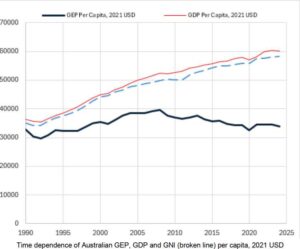 Both GDP and GNI per person trend upwards over the years, with the gap between the two series reflecting the net outflow of primary income from Australia each year, a consequence of many years of net investments in Australian assets by the rest of the world.
Australia’s GEP peaks in 2008 however, just prior to the economic impact of the Global Finance Crisis and has trended downwards ever since. This is partly a reflection of ecological costs, associated with the increasing material footprint of Australia’s exports, and the rising global social cost of emissions (not associated with land use) in a rapidly overheating world. The other big contributor is net income inequality, which greatly increased in the 1990s, but has a greater weighting in the GEP in more recent years, due to GNI per capita increasing.
The challenge is to maintain full employment and provide economic security, in an economy less reliant on fossil fuel exports and with a lower material footprint, with radically reduced net income and wealth inequality (and all that implies, including access to afford -able housing), and an accelerated transition towards minimising consumption-based domestic emissions of carbon dioxide (with all that implies for electrification and electricity generation). Then perhaps, rather than GEP falling despite the rise in GDP, Australians will be able to enjoy rising Genuine Economic Progress, regardless of whether the scale of economic activity is rising or falling.
Source:
https://substack.eom/@stevenhailaus/note/c-242072585