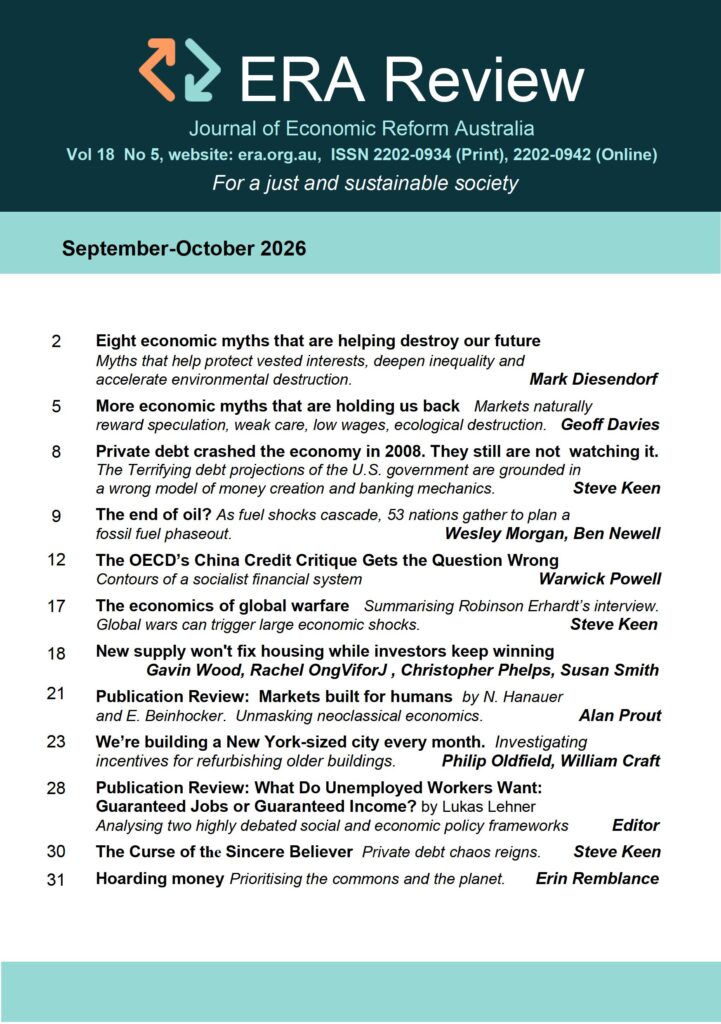
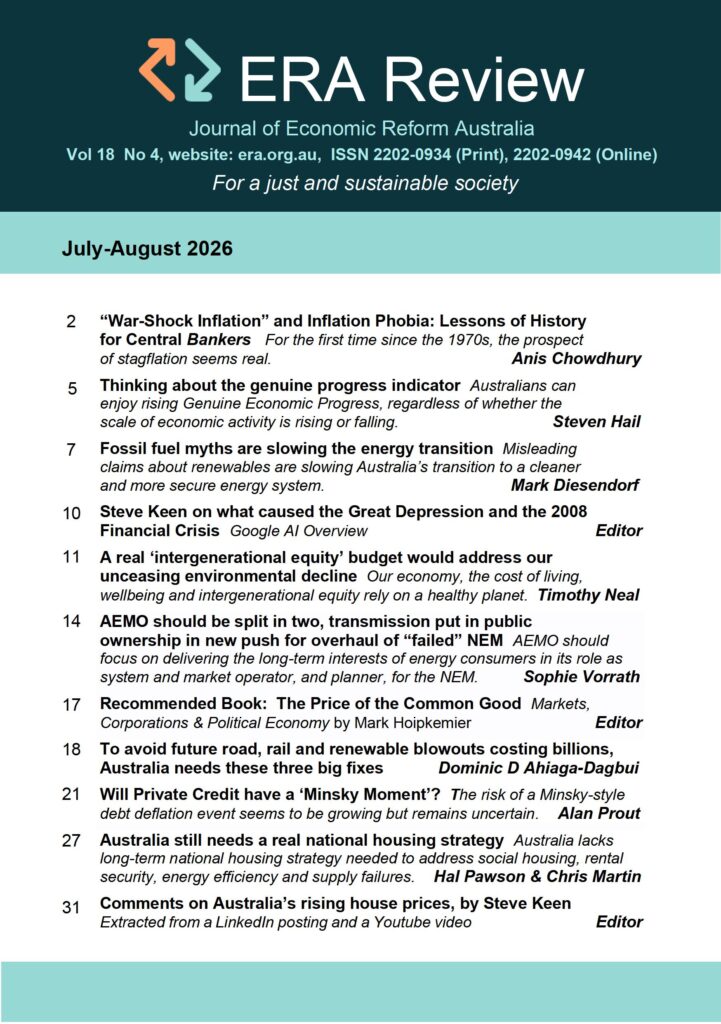
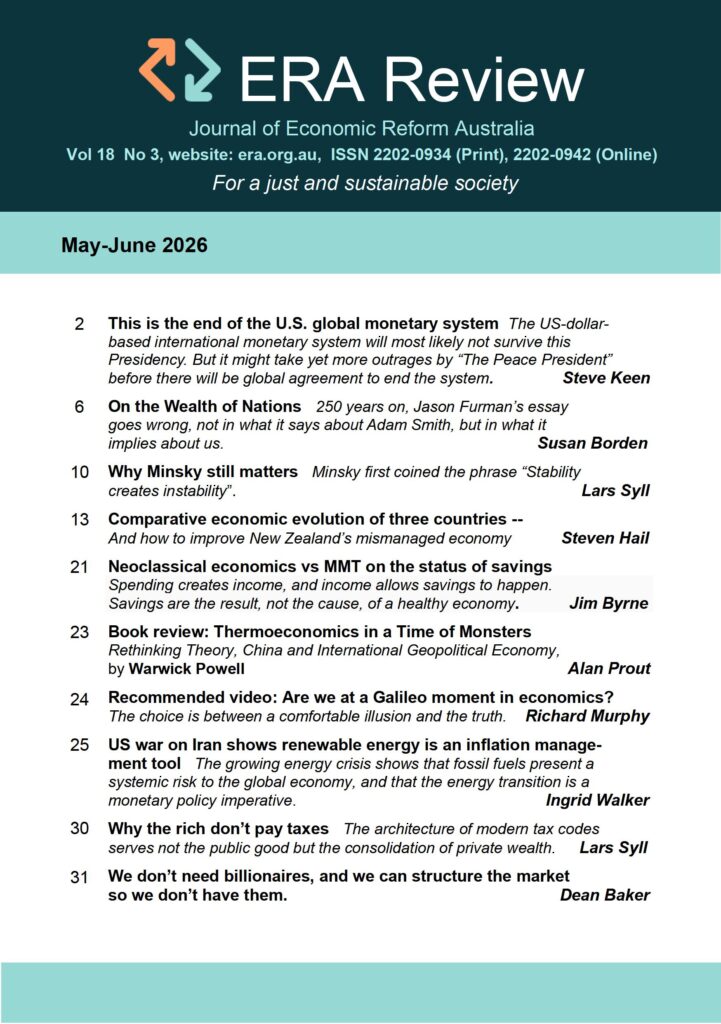
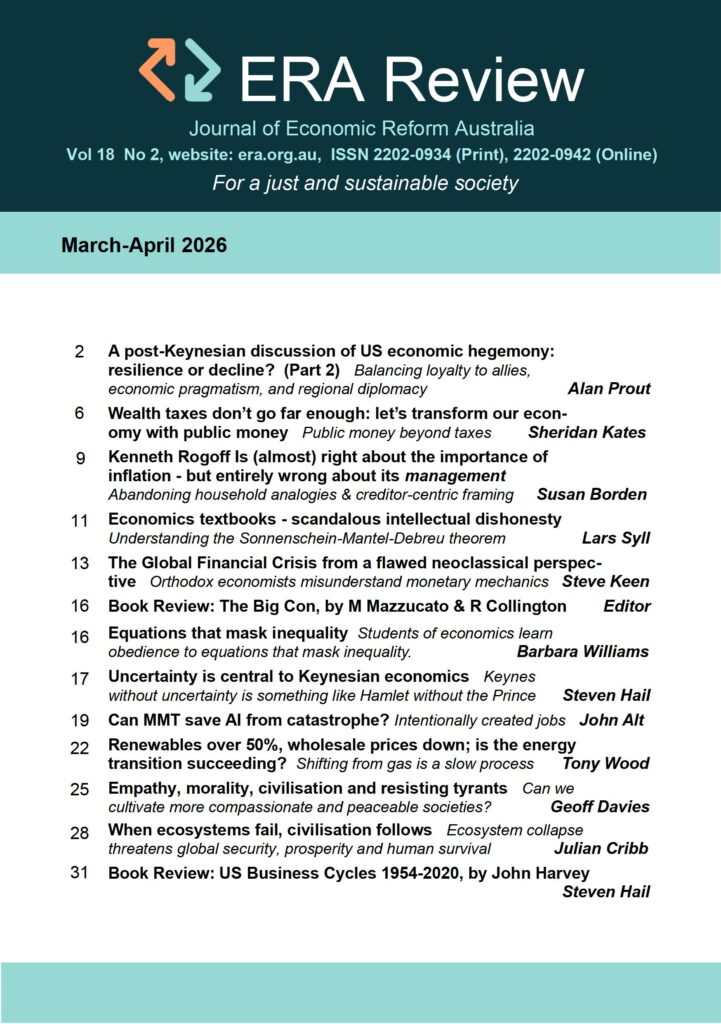
US war on Iran shows renewable energy is an inflation management tool [1]
Ingrid Walker
The growing energy crisis shows that fossil fuels present a systemic risk to the global economy, and that the energy transition is a monetary policy imperative
Key points
(a) Recurring fossil fuel price shocks triggered by geopolitical flashpoints (like the US-Israeli strikes on Iran) consistently disrupt central bank rate plans and elevate global inflation, showing that reliance on fossil fuels is a systemic threat to financial stability.
(b) Renewable energy has shifted from being a climate project to a monetary policy imperative, offering clean energy sovereignty at near-zero marginal costs, insulating economies from volatile “fossilflation” cycles.
(c) For the global south, energy independence via renewables can help to reduce exposure to dollar-denominated fuel price swings and subsequent external debt pressures.
(d) To break the cycle where higher interest rates stifle green infrastructure, central banks can introduce targeted green lending facilities to decouple the cost of clean energy capital from headline rates and maintain momentum for the transition.
The US-Israeli strikes on Iran mark the seventh major fossil fuel price shock since the 1970s. They also provide the clearest demonstration yet that the green transition is not a climate project, it is a monetary policy imperative.
The pattern is already painfully familiar. A geopolitical flashpoint sends Brent crude prices lurching upward and chaos ensues.
This time, central banks that had been preparing to cut rates found their carefully laid plans disrupted overnight, while the US two-year yield jumped half a percentage point last month alone. Meanwhile, the Organisation for Economic Co-operation and Development has already revised its inflation forecasts upward for the US, UK, and eurozone; European gas prices have doubled and stagflation anxieties are spreading.
With Brent crude peaking at nearly $120 per barrel in March — which also saw the largest monthly rise on record — the economic case for the green transition has moved decisively from theoretical debate to operational emergency.
Every oil shock ends the same way, until it doesn’t
Each fossil fuel price shock has followed a broadly similar transmission mechanism. A supply disruption -whether as a result of an embargo, a war or another geopolitical flashpoint -hits commodity markets. Because fossil fuels underpin energy costs across manufacturing, transport and agriculture, the shock reverberates through downstream prices across the economy. Central banks, whose tools were designed to cool demand-side inflation, find themselves fighting a supply-side spiral they are structurally ill-equipped to address.
Research from the Roosevelt Institute highlights a consistent pattern: crude oil price spikes have preceded 10 of the 12 post-war US recessions. The authors conclude managing prices “while retaining a fossil fuel-based economy is nearly impossible”. Rate hikes can suppress demand but can not address systemic vulnerabilities linked to fossil fuel supply chains.
The 2022 iteration of this crisis following Russia’s invasion of Ukraine offers a particularly instructive case study. Because in many countries gas sets the marginal price for electricity, a single supply disruption became the dominant transmission channel for inflation across the continent, with effects rippling out globally. In the UK, energy effects accounted for three-quarters of inflation at its peak, while European Commission analysis confirmed that gas price spikes driven by supply disruptions and fears of further shortages were “the overwhelming driver for the electricity price increase”. Rens van Tilburg, founder of the Sustainable Finance Lab at Utrecht University, recalls warning central bankers that this vulnerability would simply be re-routed, not removed, as Russian LNG was swapped for Gulf and US supplies. “I had this presentation where I was actually showing these pictures of Donald Trump, of the Strait of Hormuz, and saying, let’s not kid ourselves.” He told Green Central Banking that at the time it sounded alarmist. “Yet we could have seen this coming. We chose not to, as we so often do.”
‘Devastating’ price swings
The case for renewable energy as an inflation management tool rests not on ideology, but on the hard economics of engineering. As Frank Elderson, executive board member of the European Central Bank, noted recently, electricity from wind and solar incurs the dominant part of its lifetime costs during the construction stage, not the operating phase. Once built, renewables generate at near-zero marginal cost. There are no costly fuels to buy, no risk of shipping lanes being blockaded, and no OPEC supply decisions to navigate.
European Commission modelling confirms that a higher share of renewables “can have a very significant impact on lowering electricity prices”. While a separate study says that dicarbonising electricity generation “can increase resilience of downstream industrial sectors in most European regions”.
For Richard Folland, head of policy and engagement at Carbon Tracker, the current crisis “vindicates our approach about doubling down on the low-carbon transition”.
“It is much more difficult to weaponise energy if it’s homegrown,” he says “so you’re not dependent in that way … that, in our view, reinforc[es] not only energy security, but actually energy sovereignty.”
He also argues that plans to boost domestic oil and gas production -such as the UK squeezing more from a declining North Sea basin – would do little to ease price pressures. Both in the short term, because they would have only a marginal effect on globally set oil prices, as well as in the longer term as they would lock economies deeper into fossilflation price cycles.
According to Folland, the crisis is accelerating an already visible division between the electrostate and petrostate, whereby economies shifting to domestically controlled renewables are becoming “more insulated” than those tied to globally traded hydrocarbons. Both China and Germany have enjoyed a partial cushion from the current shock thanks to clean energy investment, even though China remains the world’s largest net oil importer and Germany is still heavily exposed via residual gas demand.
Fadhel Kaboub, associate professor at Denison University and the Global Institute for Sustainable Prosperity, says global south countries locked out of reserve currencies are “on the receiving end of this in terms of debt burdens”. As every imported barrel is priced in dollars, African economies dependent on imported fuel are, once again, being exposed to price swings that “will be devastating”.
A vulnerability that sits atop a foreign-currency denominated debt overhang that has already put governments “in a very . stressful position on foreign exchange reserves and exchange rates”. This, he says, leaves ”the African continent as a whole, [which] is spending more on debt service than on health and education combined … facing substantial pressure in terms of food and fuel imports. With everything becoming more expensive, you will see more and more countries facing the difficult choice of whether to default on external debt payments in order to continue importing food, fuel and medicine.”

Energy independence via renewables, Kaboub argues, is therefore not simply a climate necessity — it is the structural precondition for effective, sovereign monetary policy.
Critical mineral production still tied to fossil fuels
Yet Kaboub, who is also a member of the United Nations High-Level Advisory Board on Economic and Social Affairs, also warns that critical minerals, which are essential for renewable technologies, remain “technically and technologically locked into the fossil fuel system”, because key inputs for the green economy still depend on oil and gas infrastructure.
Supplies of helium, vital for advanced semiconductor manufacturing, have been disrupted due to the war. It also threatens global sulphur supplies, around 92% of which are a by-product of processing oil and gas and is crucial for critical mineral and battery metal supply chains. Indonesia, which produces more than 50% of the world’s nickel, imports roughly 75% of its sulphur from the Gulf.
Truly decoupling green value chains from the geopolitical vulnerabilities associated with oil markets, says Kaboub, will therefore require large-scale public sector commitment to research and development in material science, innovation that the fossil fuel industry has no incentive to fund. And the spectre of rising interest rates threatens to cut off innovation at precisely the moment it is most needed.
“When it comes to scientific research and innovation, we can’t be sitting on our hands and saying helium is the only way to cool … or sulfuric acid is the only way to refine critical minerals … there has to be alternatives. And we just have to invest in material science research to build the alternatives, which will be cheaper, healthier and better, but will completely make the fossil fuel industry a thing of the past.”
“We haven’t committed to enough research and development and innovation to completely decouple the fossil fuel industry from the green energy infrastructure.That doesn’t mean that we’re doomed. Just that nobody cared to invest in material science research going in this direction. Who funds the majority of material science research? It’s . the petrochemical industry. And they have no interest in producing the alternative.” “So that’s why we need public sector commitment to research and development and to material science research, publicly funded academic research. . into the circular economy, into the green infrastructure”
Van Tilburg highlights survey findings from Dutch consultancy firm Berenschot which found that in 2023, following rate hikes, around a third of Dutch Renewable Energy Association members delayed or cancelled planned investments.
Here lies the structural problem. Higher rates disproportionately hurt green investment, slowing the transition. The next fossil fuel shock arrives and rates rise again. The central bank’s primary weapon against inflation is hindering the infrastructure that would help resolve the problem in the first place.
How can central banks help break the cycle?
If fossilflation is structural, so too must be the response. Van Tilburg’s prescripttion is a targeted green lending facility — the equivalent of the ECB’s tar-geted long-term refinancing operations or the Bank of England’s term funding scheme — that decouples the cost of clean energy capital from the headline rate cycle. Under this model, banks receive cheaper refinancing for green energy loans, insulating the investment pipeline from monetary tightening. The legal mandate exists, says van Tilburg, what has been missing is political will.
“Japan and China already operate such policies. and we should not be shy to copy those policies,” he said. “Central banks should take their responsibility for the effects that fossil fuel pricing can have, and use the instruments they have like the green rate — just simply based on their mandate for price stability.”
Folland names the structural gap: “There is still a lack of joined-up policy across government, between, on the one hand, climate and energy decarbonisation policy and, on the other hand, financial policy and regulation.”
As the ECB’s Elderson said: “None of this is easy. But the real question is no longer whether Europe can afford to make the energy transition. It is whether it can afford not to. From a central banking perspective, the answer is clear.”
[1] Source article:
Green Central Banking, 17 April 2026 https://greencentralbanking.com/2026/04/17/us-war-on-iran-shows-renewable-energy-is-inflation-management-tool/
References with links can be found in the source article. Reproduced with permission of Green Central Banking.
 Ingrid Walker, a Green Central Banking contributor since 2023, has a decade’s experience in research writing. An Utrecht-based scholar, Ingrid specialises in transformative justice, green finance, law and systems change. She is an Utrecht University’s Bright Minds scholar and previously worked for Cambridge University and various justice-based NGOs.