Economic myths
Mark Diesendorf

The dominant economic system, capitalism, has the goal of generating profit through private ownership and control of the means of production. In a few cases, this goal has resulted in benefits to a large fraction of citizens of a country, for example, as achieved by the rise of the middle and rich classes under state capitalism in China in recent decades. But even in China, the poorest people actually became worse off, because their gains in incomes were outstripped by the increasing prices of basic goods and services.
Under capitalism, much of the world’s great forests has been felled, biodiversity has been decimated, land and water have been polluted, freshwater has been overused, and climate change has become an imminent existential threat.
Since the industrial revolution, capitalism and colonialism have been business partners. Indigenous communities and nations that were once self-sufficient have had their raw materials exported, with little given back to local communities, and their labour utilised for very low wages, until they have become dependent on foreign aid. Clearly, capitalism is based on exploitation of the environment and most people.
An extreme form of capitalism, neoliberalism, has dominated socioeconomic and political decisions by governments from the 1970s onwards. Neoliberalism is based on the notion that both government spending and taxes should be small and that major socioeconomic policies should be left to the market. It is still followed by governments of many countries, despite its failures during the global financial crisis of 2008 and the COVID pandemic when, in each case, governments had to spend vast amounts of money to keep their economies afloat, violating neoliberal ‘principles’.
Proponents of neoliberalism claim it is based on the ‘science’ of neoclassical economics. Yet several scientists and brave heterodox economists have challenged the validity of neoclassical economics, showing that it is based on foundations of quicksand.
While capitalism is deeply entrenched, neoliberalism is beginning to totter. Now is the time to expose its poorly based myths and ideology, and push it over. In doing so, we can also build pressure to bring capitalism under control and create a new economics with primary goals the protection of the environment, which is our life support system, social justice and at least a basic level of prosperity for all. The market must be constrained to work within these goals. In the following concise critique, for brevity we call the ideologies and claims of neoliberalism, and capitalism in general, myths’.
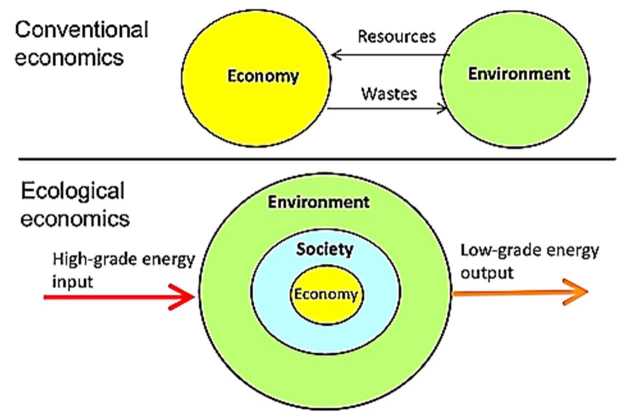
Myth 1: “The environment can be treated as separate from, and external to, the economy. Its roles are as a source of raw materials and a waste dump for the economy”.
Refutation: This myth forms one of the shaky foundations of neoclassical economics theory. The myth is illustrated in the top half of Figure 1 below. It is refuted by the findings of environmental science and ecology that we humans are totally dependent on the natural environment. We depend on it for a stable climate within a suitable temperature range, an atmosphere that absorbs most harmful ionising and ultraviolet radiation from space, the air that we breathe, photosynthesis, the natural cycles (water, carbon, oxygen, nitrogen, phosphorus, etc.), and the bacteria in our stomachs that help us to digest food. We cannot exist independently from the natural environment. Therefore, we must redesign our economic system to become part of the environment, a part that’s entirely compatible with the host system, not a disease that undermines it. More precisely, economics must become part of a social system that’s compatible with the environmental host, as shown in the bottom half of figure 1, which represents the transdisciplinary field of ecological economics.
Myth 2: “The gross domestic product (GDP) is a meaningful measure of wellbeing or welfare of society”.
Refutation: GDP was not designed for this purpose. It is an inappropriate measure because it measures economic quantity, not economic quality or welfare, let alone social or environmental wellbeing. In particular: (i) GDP counts environmentally and socially destructive economic activities as positives along with beneficial activities.
(ii) GDP ignores the important role of unpaid work, e.g. household work, care work and volunteer work. In particular, GDP devalues women’s unpaid work. In monetary terms, unpaid work is equivalent to a large fraction of GDP in many countries. It underpins labourforce participation, human-capital formation, and community functioning. (iii) GDP takes no account of the distributions of wealth and income.
Some national economies have both a high GDP per person and a large proportion of its population in poverty.
An alternative economic indicator is the Genuine Progress Indicator; an alternative socioeconomic indicator is the Human Development Index. However, many sustainability researchers do not accept that a single indicator is sufficient to give a fair representation of wellbeing and recommend several additional environmental, social and political indicators.
Myth 3: “Endless growth in consumption on a finite planet is feasible and desirable”.
Refutation: The myth depends on the notion that economic growth, which is measured in terms of GDP, can be somehow decoupled from physical growth, i.e. growth in the use of energy, materials and land, and in population. In other words, it assumes ‘green’ growth is possible. In reality, while improvements in efficiencies in the use of materials and energy can reduce the increase in environmental impacts per unit of increased GDP, they cannot generally result in absolute reductions in impacts. Even schools require buildings, equipment and data centres. Even growth in energy consumption that’s produced entirely from renewable sources indirectly drives more industry and directly consumes more materials. The result of continuing economic growth is that environmental impacts have exceeded seven out of nine safe planetary boundaries.
Myth 4: “Major socioeconomic and political decisions should be left to the market”.
Refutation: This neoliberal myth is based on the unrealistic assumption that markets are free and perfect. In practice, most markets are controlled by large corporations and a few very rich individuals. The control is exercised directly by dominating markets and indirectly by state capture to shape government policies and public attitudes using such methods as political donations, revolving door jobs, concentrated media ownership, so-called ‘think tanks’, inadequately regulated lobbying and consultancies for government, and the biased, unsustainable, dominant, economic system.
Myth 5: “Wealth trickles down from the rich to the poor”.
Refutation: A major survey of 18 OECD (wealthy capitalist) countries spanning the half-century 1965-2015 finds that tax cuts for the rich do not have any significant effect on economic growth or unemployment. However, they do lead to higher income inequality in the short- and long-term. Economic ‘development for the people’, which is based on public ownership, has a different outcome from ‘development for capitalists’.
Myth 6: “The value of anything is determined by the market”.
Refutation: A few counter-examples will suffice:
(a) How can the market put a price on runaway climate change, which could destroy industrial society?
(b) The networks of fungi attached to the roots of most trees have no market value but are essential for the nutrition of trees and hence for the oxygen supply for life on Earth.
(c) Does unpaid caring of elderly, sick or disabled people have no value to society?
Myth 7: “National governments of countries with monetary sovereignty must balance their budgets. The consequences of failure are inflation and huge debts imposed on future generations”.
Definition: A monetary sovereign country has a central or federal government which issues a fully fiat currency, that is, a currency created and backed by government that is not convertible at a guaranteed fixed rate into any commodity, such as gold, or into any foreign currency. It floats on the foreign exchange market. Furthermore, the currency issuer must not have significant net financial liabilities denominated in foreign currencies. For example, Australia, China, Japan, UK and USA are all monetary sovereigns but the member countries of the EU and state/provinc-ial governments are not.
Refutation: Most OECD (i.e. wealthy) countries have budget deficits for most years without having high inflation.
However, if total spending (public + private) exceeds national economic capacity (physical resources, workforce, skills, education, infrastructure), then inflation becomes likely. A government deficit or ‘debt’ is simply an excess of money in the private sector; it does not have to be ‘paid back’. If governments create money by issuing bonds, they must pay interest; alternatively, they can spend money into existence without creating bonds and without paying interest.
Myth 8: “A unique Non-Accelerating Inflation Rate of Unemployment (NAIRU) exists and is a useful policy tool for managing inflation”. In simpler language, “Inflation can and should be managed by increasing unemployment”.
Explainer: Inflation arises when demand for goods and services is greater than supply. This can be the result of either excessive demand or insufficient supply, or both. In other words, if demand is greater than national economic capacity (raw materials, industries, labourforce, skills, education) and available imports, then inflation is the likely outcome.
The NAIRU emerged in the 1970s as the key part of the neoliberal method of controlling inflation. The method assumes there is a trade-off between inflation and unemployment. It reduces inflation by reducing demand with policies to increase unemployment. The notion is that when unemployment is above a chosen NAIRU value (say 4%), then inflation should decelerate and vice-versa. This alleged relationship is called the Phillips curve. A result of adopting this notion was that the former goal of full employment was abandoned or, more precisely, ‘full employment’ was redefined to be the NAIRU. In Australia, and many other OECD countries, the Reserve Bank and Treasury are strongly influenced by the NAIRU notion.
Refutation (comments welcome): Empirically, the relationship between inflation and unemployment does not generally follow a Phillips curve. The theoretical justification depends on dubious assumptions of neoclassical economics, e.g., the economy is assumed, contrary to observation, to be a static system with equilibrium between supply and demand. The various methods of choosing the value of the NAIRU are arbitrary, inconsistent with one another, and change with time. If there is a severe shortage of supply, as occurred globally following the COVID pandemic, reducing demand by increasing unemployment causes unnecessary hardship without addressing the cause of inflation, lack of supply.
As the rich are the biggest spenders (and by far the biggest emitters of greenhouse gas emissions), demand side measures to control inflation (and simultaneously reduce emissions) should focus on reducing spending by the rich, for example, by taxation, savings bonds, superannuation, and regulation. The government can increase supply by allocating a larger proportion of its spending to increasing the national economic capacity, e.g., by expanding education, training and infrastructure, and by closing gaps in key supply chains.
Myth 9: “The economic impacts of substantial global heating (3-6 °C) would be trivial”.
Refutation: These claims, by several economists, including a winner of the Bank of Sweden Prize in Economic Sciences in memory of Alfred Nobel -William Nordhaus — rest on flawed assumptions and have been refuted by leading climate scientists and ‘heterodox’ economists.
Source: https://www.markdiesendorf.com/economic-myths
Mark welcomes constructive comments via his email – [email protected]
Dr Mark Diesendorf was originally a physicist who expanded into interdisciplinary research on energy and sustainability. Previously he was Professor of Environmental Science and Founding Director of the Institute for Sustainable Futures, University of Technology Sydney. Currently he is Honorary Associate Professor in the Environment & Society Group in the School of Humanities & Languages, UNSW Sydney. Mark is the lead author of ‘The Path to a Sustainable Civilisation: Technological, socioeconomic and political change’ (Palgrave Macmillan, 2023). Web: https://research.unsw.edu.au/people//associate-professor-mark-diesendorf.