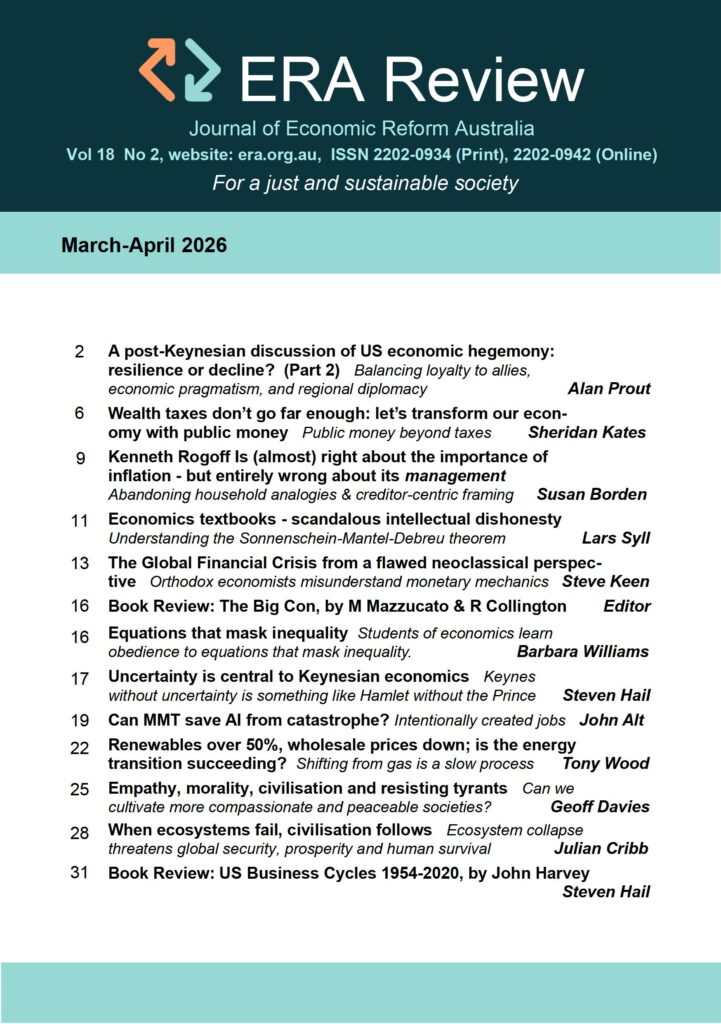
Uncertainty is central to Keynesian economics
Steven Hail
This item is extracted from Steven Hail’s 2018 book Economics for Sustainable Prosperity. The discussion relates to the 2012 paper written by Paul Davidson “Is economics a science? Should economics be rigorous?” [1], as well as to a recent debate between Davidson and Lars Syll [2].
Paul Davidson would say the economy is a non-ergodic system. An ergodic system is one governed by probability distributions which in principle are available to be discovered. Even if the cost or complexity of gathering the necessary information to estimate these probabilities is prohibitive, or beyond our cognitive capacities, so that the situation is uncertain in an epistemological sense (in terms of what can be known), the environment could be described as ergodic if that information existed. In a non-ergodic system, the probabilities of future outcomes are unknowable because they do not and cannot exist. They remain to be created. George (G.L.S.) Shackle described a decision as ‘a cut between past and future, an introduction of an essentially new strand into the emerging pattern of history’. As Shackle put it, ‘the future, which will be partly created by this choice and a million similar contemporary ones made by other decision makers, does not yet exist’.
Non-ergodic systems are governed by processes which are uncertain, not due to human cognitive limitations and/or research costs, but in a more fundamental way – because of the current crucial, inter-connected and irreversible decisions of many individuals, who do not make decisions in a stable environment, but instead collectively create that environment by their decisions and actions. The billionaire George Soros has called this ‘reflexity’. Davidson has often compared the non-ergodic environment of Keynes to the approach taken to what can be known by Robert Lucas and all those building models based on rational expectations. For Davidson, rational expectations models assume objective probabilities, which can be learned based on the relative frequencies with which states of nature occur in a stationary environment. The agents in rational expectations models behave as though they are aware of how the economy functions, and they never make even theoretically predictable errors. All the available information which has relevance to forecasts of future values of economic variables is taken into account whenever decisionmakers form their expectations of those future values. It is assumed that they do not use heuristics or conventions – they optimise. This is built into orthodox dynamic stochastic general equilibrium models.
Davidson, Shackle, Soros and Keynes argue that there is insufficient ‘available information’ to allow for anyone to optimise in this way, where decisions with long-term consequences are concerned, and in highly volatile environments, such as a financial crisis, even for short-term decisions. What are the expected returns and risks of this longterm capital investment decision? We simply do not know. We are making decisions between an unchangeable past and an unknowable future. We don’t know the circumstances that will arise, and as John Hicks put it in his Causality in Economics, ‘people know that they just don’t know’. By the late 1970s, Hicks, the co-founder of the first neoclassical synthesis, had gone a long way towards becoming Hicks, the Post-Keynesian – far closer to Davidson and Shackle in some of his views than to Samuelson and Tobin.
This means that the rational expectations of decision-makers in modern orthodox general equilibrium models are either infeasible, or have to be interpreted in such a way as to be tautological and essentially meaningless. In a similar context, and many years before any formal definition of rational expectations existed, Keynes had referred to the ‘pseudo-rationalistic notions’ of the ‘extraordinary contraption of the Benthamite School’.
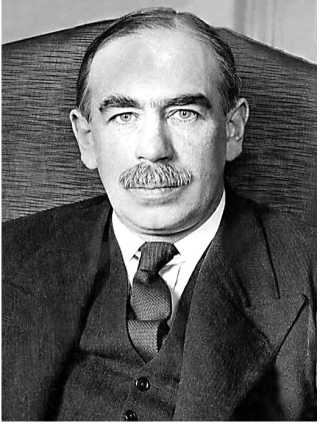
Uncertainty is central to the economics of Keynes. As Hyman Minsky put it, ‘Keynes without uncertainty is something like Hamlet without the Prince’. A sophisticated understanding of the nature of uncertainty is a starting point for understanding the following: (a) the importance of liquidity and the special role of money in an uncertain capitalist economy;
(b) the reasons why money and finance can never be neutral;
(c) the causes of path dependence in the economy, and of cumulative causation;
(d) the inadequacy of the efficient markets hypothesis as compared to a liquidity preference theory as an explanation of the behaviour of financial markets over time;
(e) the volatility of investment spending;
( f ) the operation of the economy as a complex social system; and
(g) the tendency of the economy towards instability and disequilibrium at it evolves over time, as described by Minsky.
References:
1. Davidson, Paul; Is economics a science? Should economics be rigorous?
RWER no 59 https://www.paecon.net/PAEReview/issue59/Davidson59.pdf
2. Syll, Lars; Paul Davidson and yours truly on uncertainty and ergodicity RWER Blog. 29 Jan 2026
https://rwer.wordpress.com/2026/01/29/paul-davidson-and-yours-truly-on-uncertainty-and-ergodicity/