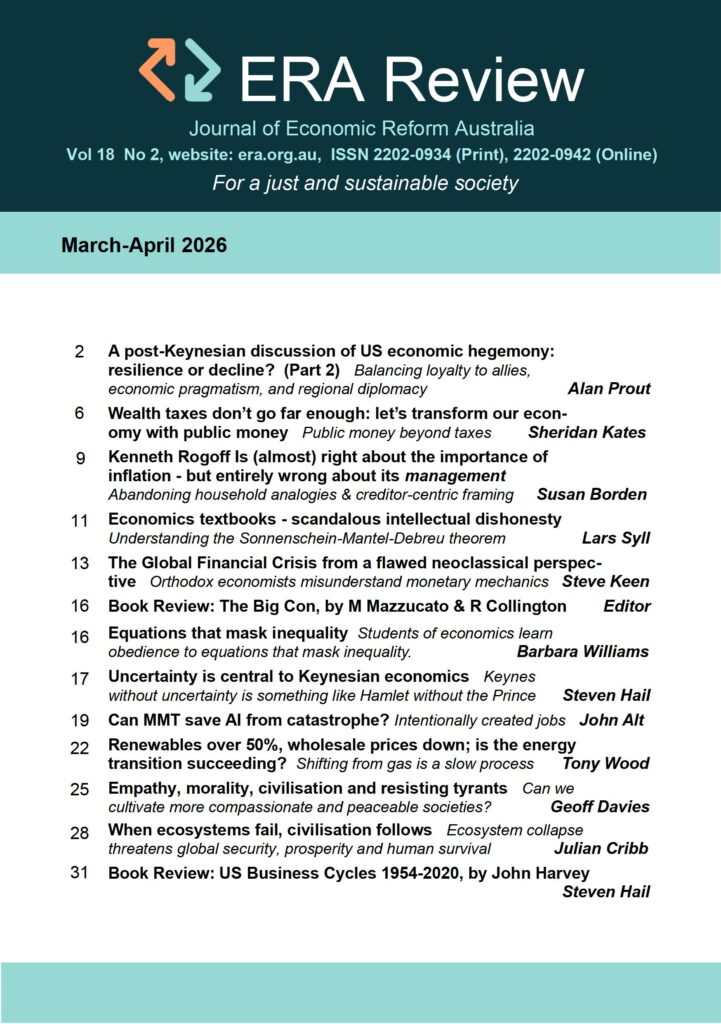
Economics textbooks — scandalous intellectual dishonesty
Lars Syll
It is well-known that Keynes frequently criticised more traditional economics for committing the ‘fallacy of composition’. This fallacy essentially involves the mistaken belief that the whole is nothing more than the sum of its parts. Keynes argued that this is simply not the case in either society or the economy, and that, a fortiori, an adequate analysis of either cannot proceed by simply adding up the acts and decisions of individuals. The whole is greater than the sum of its parts.
This issue is evident when mainstream economics attempts to argue for the existence of ‘The Law of Demand’ on an aggregate level — the idea that when the price of a commodity falls, the demand for it will increase. While one might succeed in establishing this law for single individuals, it was firmly demonstrated by the Sonnenschein-Mantel-Debreu theorem as early as 1976 that it is impossible to extend ‘The Law of Demand’ to the market level, unless one makes wildly unrealistic assumptions, such as all individuals having homothetic preferences – which effectively implies that everyone has identical preferences.
This would only be conceivable if there were, in essence, only one actor – the (in)famous representative agent. So, yes, it was possible to generalise ‘The Law of Demand,’ provided we assumed that on the aggregate level there was only one commodity and one actor. What a glib generalisation! Does this sound reasonable? No, of course not. It is utter nonsense.
How has mainstream economics reacted to this devastating finding? Essentially by looking the other way, ignoring it, and hoping no one notices that the emperor has no clothes.
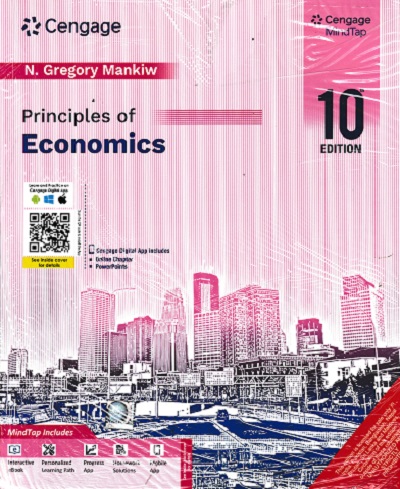
Having reviewed a handful of the most frequently used economics textbooks at the undergraduate level today, I can only conclude that the models presented in these modern mainstream works attempt to describe and analyse complex, heterogeneous real economies that use a single rational-expectations-robot-imitation-representative-agent.
That is, with something that has absolutely nothing to do with reality. And — worse still — something that is not even amenable to the kind of general equilibrium analysis it is supposed to underpin, since Hugo Sonnenschein (1972), Rolf Mantel (1976), & Gerard Debreu (1974) unequivocally showed that no set of assumptions about individuals could guarantee either stability or uniqueness of the equilibrium solution.
Consequently, what our modern economics textbooks present to students are models built on the assumption that an entire economy can be modelled as a representative agent and that this is a valid procedure. But it is not, as the Sonnenschein-Mantel-Debreu theorem has irrefutably demonstrated. One could, of course, argue that it is too difficult at the undergraduate level to explain why the procedure is correct, and that this should be deferred to master’s and doctoral courses. Such a justification would be reasonable — if what you were teaching your students were true, if The Law of Demand were generalisable to the market level and the representative agent were a valid modelling abstraction! But in this case, it is demonstrably false, and therefore, this is nothing short of scandalous intellectual dishonesty. It is like telling your students that 2 + 2 = 5 and hoping they never encounter Peano’s axioms of arithmetic.
For more than fifty years, mainstream economics has lived with a theorem that demonstrates the impossibility of extending the microanalysis of consumer behaviour to the macro level (unless one makes patently absurd assumptions). To pretend in their textbooks, after all this time, that this theorem does not exist — not one of the textbooks yours truly investigated even mentions the Sonnenschein-Mantel-Debreu theorem — is outrageous.
Source: RWER blog, 25 Nov 2025 https://rwer.wordpress.com/2025/11/25/economics-textbooks-scandalous-intellectual-dishonesty/#more-46936