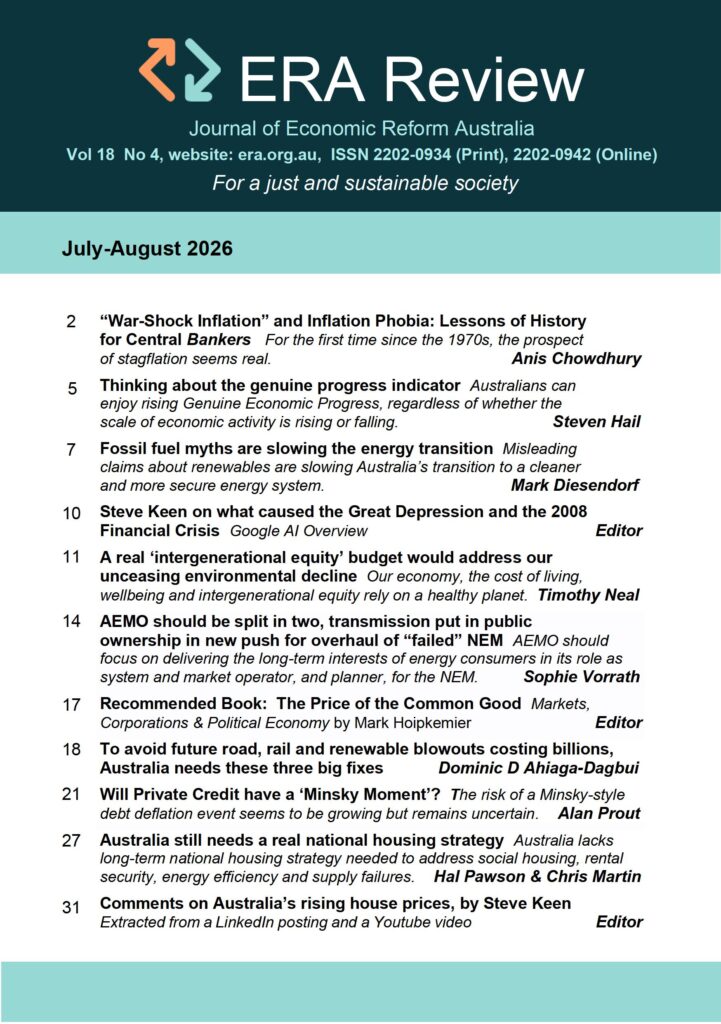
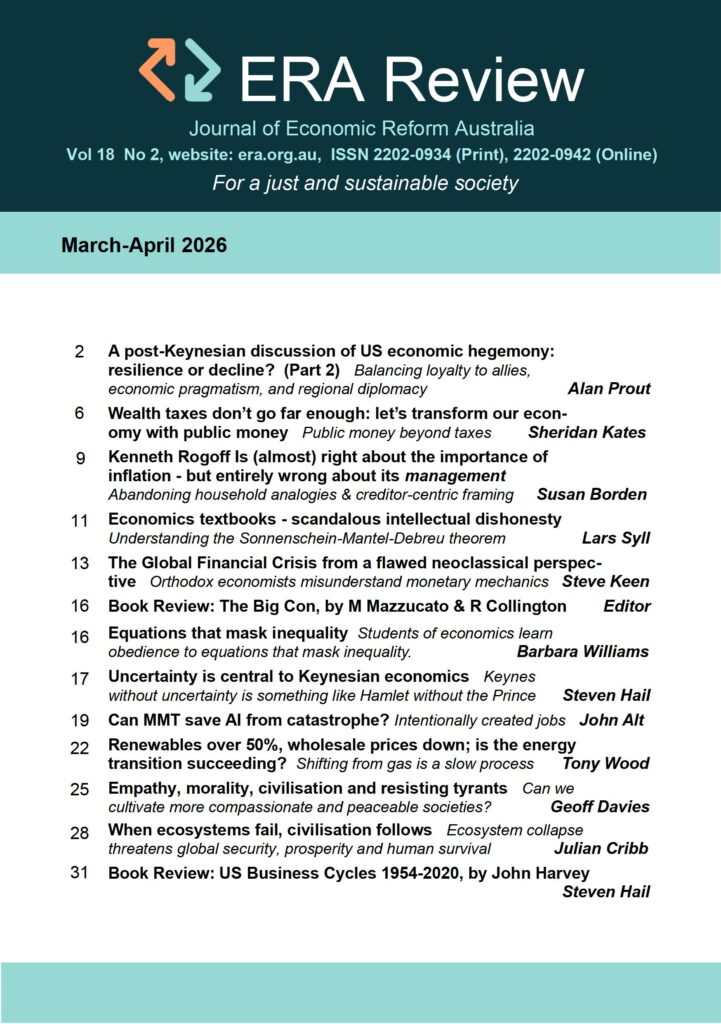
A post-Keynesian discussion of US economic hegemony: resilience or decline? (Part 2)
Alan Prout

In Part 1 we listed some long-term factors that contribute to the erosion of trust in U.S. currency: deindustrialisation, financialisation, inequality and political gridlock.
Each of these betokens the failure of the neo-liberal agenda instituted by Reagan (and Thatcher) in the 1980’s. Far from their vision of a perfectly functioning, equitable market system, these neoliberal fiascos tend to interact and over-determine each other. For example, continuing unequal distributional outcomes are liable to generate political uncertainty, instability and extremism. The recent rate hikes flowing from heightened Treasury bond yields, for example, have pushed US mortgage rates to more than 6.5%, straining household budgets and cooling the housing and labour markets -both important factors in the outcome of the last US presidential election.
Trump’s tariff policies further exemplify these problems and underline growing fragility of US economic hegemony.
The Trump administration’s 2025 tariff escalation – peaking at 145% on Chinese goods – was met with reciprocal measures that exposed US dependence on Chinese imports. The quiet exemption of consumer electronics from tariffs was a tacit admission that the US cannot easily decouple from China.
Powell argues that current US policies are not just economically flawed but strategically self-defeating. By weap-onising trade, the US risks alienateng allies and causing companies to find new trading partners and governments to develop novel strategic economic alliances that give them greater independence from the USA. Examples abound. Canada, for instance, has developed the Trans Mountain Pipeline Expansion and, deeply unpopular with environmentalists as this is, it gives Canada greater independent access to non-US oil markets (The Financial Times, 2024). It is also developing a renewable energy scheme with Denmark, bringing together Canadian natural resources and Danish engineering know-how (Alberta Innovates, 2025).
By contrast, the prohibition or restriction of critical mineral exports from China to the US underscores the vulnerability of American supply chains. Similarly, there is longstanding and widespread scepticism that the US still has the manufacturing skills and the know-how, or even the educational and transport infrastructure, to support Trump’s much vaunted reshoring of industrial production (Federation of American Scientists, 2024). In fact, the Atlas of Economic Complexity suggests that the US is losing its capacity for complex production whilst China’s is increasing (Harvard Growth Lab, 2020).
At the same time, China’s reliance on the US market is shifting. For over a decade it has been addressing its over-dependence, developing new trading relationships with countries of the Pacific Basin. China’s trade is increasingly anchored in the broader Pacific region, with its largest partners being Asia-Pacific economies such as ASEAN, Japan, South Korea, and Australia, alongside the United States. In 2020, ASEAN overtook both the US and the EU to become China’s single largest trading partner.
Finally, in the background is the slow but steady rise of alternative economic blocs like BRICS – which is incrementally creating alternative financial institutions such as the BRICS Clear (Economic Times, 2024) and Pan African Payments and Settlement systems (FX Intelligence, 2025). China has also developed an alternative to the SWIFT bank clearing system, the Cross-border Interbank Payments System (CIPS), that uses the renminbi not the US dollar. It is used by 54% of Chinese firms, a larger proportion than using the dollar-based SWIFT system. These developments may be at the margin but incrementally and cumulatively over the long term, they can be the irresistible force that shifts the immovable object.
The Pattern of Hegemonic Ascent and Decline
Hegemony, both its acquisition and its loss, is complex. As historian Adam Tooze (2014) has shown of US hegemony in the twentieth century, its rise involved an intricate and unpredictable dance between economic change, geopolitical manoeuvre, the achievements and the failures of international organisations, as well as wildcards played in national and even local political rivalry. Now, in the twenty-first century, we would certainly have to add climate change, the environmental crisis, energy challenges and the risk of nuclear war as key factors, with which the ebbs and flows of hegemony are bound to be entangled.
But sometimes it is helpful to take a long view, at least as a thought experiment. According to the world systems theorist Immanual Wallerstein (Halsall, 1997), there have been three hegemonic powers since the advent of modern capitalism in the post-feudal world of the fifteenth century. Spain and Portugal initially attempted (but failed) to achieve hegemony. The first to be successful was the Netherlands in the 17th to 18th centuries. The second was Britain from the 18th through the 19th and early 20th centuries. The third was the USA, more or less from 1914 onwards.
Each gained momentum in a similar way by gradually building productive and trading pre-eminence, accompanied by increasing political and military prowess. According to Giovanni Arrighi (1994) each hegemonic state eventually financialised its economy -a process that hollowed out its political and economic institutions, prefiguring its decline and replacement by a challenger. In this long view, the decline of US dominance seems clear. The structural foundations of US economic hegemony are eroding. Equally, the growing economic and geopolitical strength of China marks it as the prime challenger. However, though the trend seems clear, the distance travelled and the pace of the journey are not.
Dilemmas of Sub-imperial Nations
The USA is not at all fated to follow the same path as the UK, the hegemon it replaced by 1945 (or earlier according to Tooze). It is not even necessary that a new hegemon, say China, is bound to replace the USA. Perhaps we are entering a new phase, be it relatively long-lived or not, of a multi-polar world in which small and medium-sized nations have more sway and a louder voice. We can hope. It is also possible that the path of US decline might itself be moderated or even reversed, though that outcome would need new domestic political forces and leaders to emerge and consolidate their power and influence. This has, arguably, happened before, notably in the 1930s and 40s with FDR and the New Deal. But equally there is a strong case, as Nick Bryant (2025), the former BBC correspondent in New York, has persuasively argued, that Trump is not an isolated or unusual figure in US politics. Rather he represents long-standing conflicts (inter alia over democracy, race and the role of government) in which Americans wage a ‘forever war’ on each other.
The position of medium-sized countries trying to find their way on this shifting terrain is difficult. Australia is a key case in point. It acts as a sub-imperial regional power by aligning itself closely with US strategic interests in the Indo-Pacific (as it once aligned itself with the UK). This boosts its security and influence but creates dilemmas. Economically, Australia depends on China, yet sometimes adopts a confrontational stance, risking trade fallout. Sovereignty is strained by deep US military integration, limiting independent policy choices. Regionally, Australia’s interventions in Pacific nations can appear paternalistic, undermining trust. Balancing loyalty to allies, economic pragmatism, and regional diplomacy is increasingly complex. Navigating these tensions requires recalibrating its role, a task made more difficult and unpredictable when US hegemony itself seems to be weakening.
Whatever the path Australia follows, these are debates that will shape its future. For organisations like ERA the question is how to insert heterodox economic analysis into the discussion and turn the nation away from the failed neoliberal agenda.
Dr Alan Prout is a (retired) sociologist who has held professorships at Stirling, Leeds and Warwick, as well as earlier posts at Cambridge, Keele and Hull. He is inclined towards an interdisciplinary approach, with a BA in sociology and history, MA in Russian history, PhD in medical anthropology and PhD (causa honoris) in the sociology of childhood. Twenty years ago, in the run up to the GFC, he developed an interest in economics and has been trying to educate himself in the field ever since. He recently migrated to Australia, and lives in Adelaide.
References (Part 2)
Alberta Innovates (2025) Alberta technology leadership in Europe: Alberta Innovates and Denmark sign MOU on CCUS cooperation. Available at: https://albertainnovates.ca/news/alberta-technology-leadership-in-europe-alberta-innovates-and-denmark-sign-mou-on-ccus-cooperation. (Accessed 31 August 2025).
Arrighi, G. (1994) The Long Twentieth Century: Money, Power, and the Origins of Our Times. London: Verso.
Bryant, N. (2025) The Forever War: America’s Unending Conflict with Itself. London: Bloomsbury Continuum.
Economic Times (2024) BRICS nations agree to boost trade, financial settlement in local currencies. Economic Times, 24 October. Available at: https://m.economictimes.com/news/economy/foreign-trade/brics-nations-agree-to-boost-trade-financial-settlement-in-local-currencies/amp_articleshow/114513017.cms. (Accessed 31 August 2025).
Federation of American Scientists (2024) Restoring U.S. leadership in manufacturing.
Federation of American Scientists, 30 April. Available at: https://fas.org/publication/restoring-u-s-leadership-in-manufacturing/. (Accessed 31 August 2025).
Financial Times (2024) Canada’s oil industry cuts reliance on US market as pipeline expands. Financial Times, 2 May, 2024. Available at: https://www.ft.com/content/63b034ad-78f3-428e-a754-7f5cf509b1b0 (Accessed 31 August 2025).
FXC Intelligence (2025) The Pan-African Payment and Settlement System’s continued growth. FXC Intelligence, 13 March. Available at: https://www.fxcintel.com/research/analysis/pan-african-payment-and-settlement-system-march-25. (Accessed 31 August 2025).
Halsall, P. (1997) Modern History Sourcebook: Summary of Wallerstein on World System Theory Archived 2007-10-26 at the Wayback Machine, August 1997. Consulted 31st August, 2025.
Harvard Growth Lab (2020) Atlas of Economic Complexity – United States. Harvard University, Center for International Development. Available at: https://atlas.hks.harvard.edu/countries/840. (Accessed: 1 September 2025).
Tooze, A. (2014) The Deluge: The Great War and the Remaking of Global Order, 19161931. London: Allen Lane.