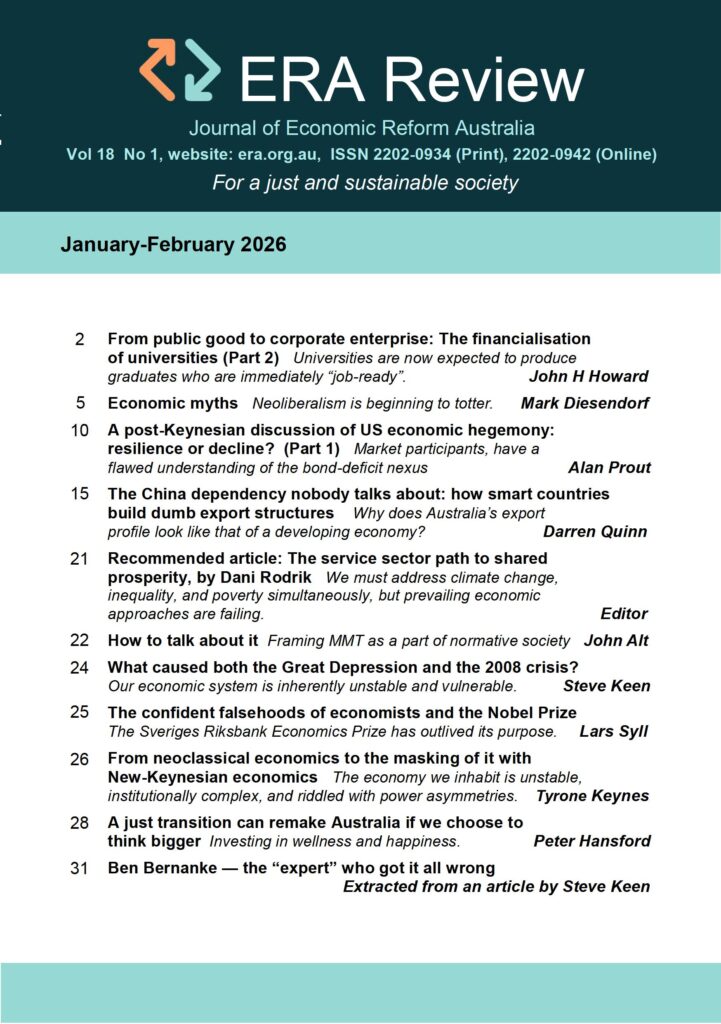
How to talk about it
John Alt
Framing MMT as a Part of Normative Society
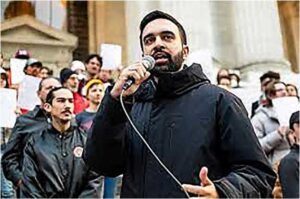
Zohran Mamdani [1] will soon be asked the question: How are you going to PAY for it? And he will be forced by the conventional logic of “finite money” to give the only answer that logic allows:
“There is only so much money available for the non-profit-making goods and services we need for our collective well-being — and that finite quantity of money can only be obtained from the people who HAVE money in the first place. Because … where ELSE would it come from?”
The whole point of this Substack is that Modern Money Theory (MMT) has described and explained, in detail, a completely different answer:
“The dollars to pay for universal childcare, free public transit, paid family leave, and affordable housing will be created by the mechanisms of modern fiat money – mechanisms which do not require additional taxes or borrowing dollars that must be repaid with future taxes.”
The problem for Mr. Mamdani is that while this much better answer has been fully operational now for over half a century, the general public has been convinced – and is still being led to believe – that such a statement cannot possibly be true. Case in point: Our national government shut itself down for well over a month ostensibly because it could not afford to pay its share of the people’s healthcare premiums! “There is only so much money,” the shut-down was saying, “and the political battle we’re going to have is over whether we are going to take more of it from the people who have it to pay for someone else’s healthcare – or someone else’s lunch, or someone else’s apartment.”
So long as money is framed this way, the fight is never-ending – and it is virtually impossible for a serious politician to stand up and do the necessary reframing (using the logic of MMT) without being laughed out of the political arena: The earth is round, you say? What a fool!
Just as Bernie Sanders and Ocasio-Cortez have already opted out, I doubt Mr. Mamdani will give the re-framing a try. And this poses a profound dilemma for the well-being of collective society: If our most progressive political leaders cannot even talk about the mechanism by which we pay ourselves to take care of ourselves, how are we ever, really, to be taken care of?
From my perspective, the only way around this dilemma is to find another way to talk about it – a new framing progressive politicians can forcefully articulate without seeming to step outside the normative boundaries of “reality”. One such framing that comes to mind is the advocacy for a National Public Banking system.
Public Banking – the normalization of modern fiat money
The general public somehow understands that “banks” and “banking operations” are legitimate parts of the normative money system. Never mind that their workings are generally obscure and misunderstood, bankers and banking are generally trusted parts of “reality”. If MMT can be seamlessly integrated into the world of banking, progressive politicians can forcefully advocate for fiat money operations without risking the danger of actually referring to them. Advocating for a National Public Banking system provides the opportunity to do just that.
This alternative MMT framing is simplified by the fact that the federal Public Banking Act of 2023 has already been proposed in the U.S. Congress where it currently languishes (unfortunately) in the House Committee for Financial Services. Even in this state of limbo, however, the proposed legislation can be a useful foil to the question “How are you going to PAY for it?” This is because a National Public Banking Act potentially embodies the essence of Modern Money Theory itself.
A Public Bank is simply a non-profit-making bank that is chartered specifically to finance non-profit-making goods and services for the public wellbeing. The crucial component of the proposed federal Public Banking Act is that it establishes Public Banks as part of the Federal Reserve Banking System. And, since the Federal Reserve System is the very heart of the modern fiat money operations that MMT describes, its mechanisms are implicitly applied and incorporated into Public Banking.
Specifically, just as the central bank issues new reserves (fiat dollars) as necessary to meet private bank-dollar claims during the “clearing” or “payments” process at the central bank, it also will issue new reserves (fiat dollars) as necessary to meet public bank dollar claims during the same clearing /payments process. Just as the central bank trades new reserves (fiat dollars) for assets from private banks, it will trade new reserves for assets from the public banks as well. Just as there is no limit to the reserves that the central bank can issue in support of private, profit-making enterprise, there is also no limit to the reserves it can issue in support of public, non-profit-making initiatives.
The limits are not imposed by the central bank’s ability to key-stroke reserves into existence — but rather are imposed by the private (and now public) bank’s ability to finance the marshalling of real resources to produce real goods and services.
So, when Zohran Mamdani is asked, “How are you going to PAY for it?” he can skip the politically divisive answer about raising taxes on the wealthy and the “delusional” MMT answer about simply issuing new fiat money out of thin air. Instead, he can advocate for the passage of the federal Public Banking Act — and explain how it will enable a Public Bank in New York City to finance rent subsidies, how it will enable Public Banks in every other state in the U.S.A. to finance universal preschool childcare, and how it will enable Public Banks in every major city in each of those states to finance free-to-ride public transit.
And, Zohran Mamdani can truthfully say all this can be done without collecting a single extra dollar in taxes. That should put a wrench in the workings of our relentless, self-defeating political warfare.
Source: John Alt’s Substack, 16 Nov 2025 [email protected]
1. Zohran Kwame Mamdani is an American politician who is the mayor-elect of New York City. A member of the Democratic Party and the Democratic Socialists of America, he has served as a member of the NY State Assembly for the 36th district since 2021, representing the Queens neighborhood of Astoria. He is set to become the city’s first Muslim and first Asian American mayor.