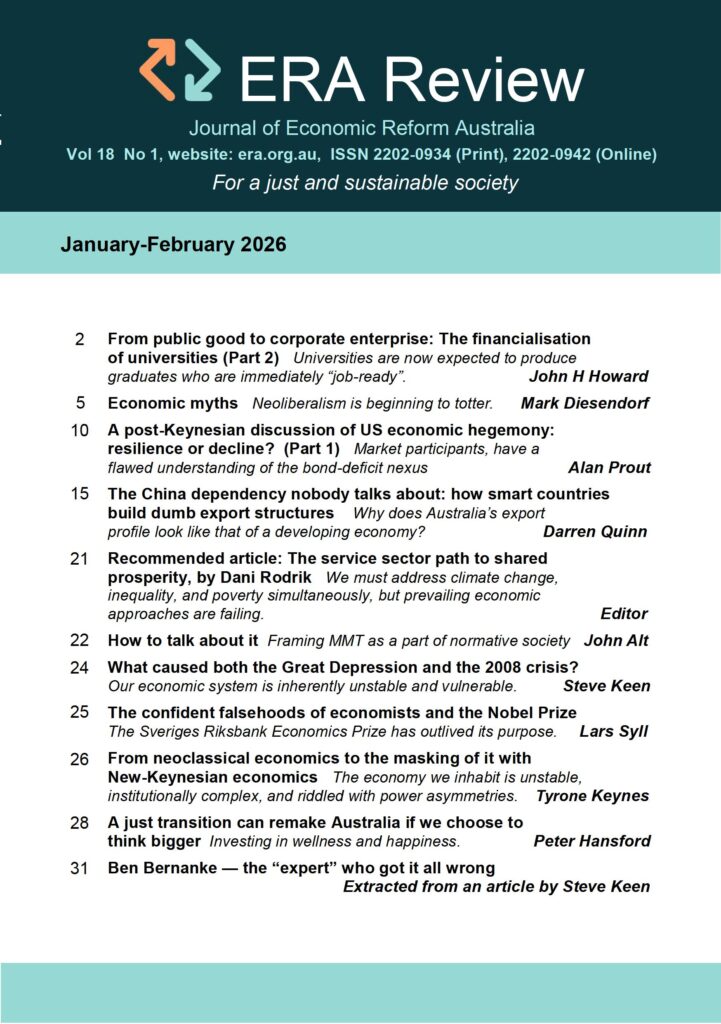
A post-Keynesian discussion of US economic hegemony: resilience or decline? (Part 1)
Alan Prout

Introduction
Since 1945 the USA has, at least until recently, been the unchallenged hegemonic power, exercising the power to shape global economic rules, norms, institutions and outcomes in ways that serve its interests. This dominance is based on several entrenched adventages (Ikenberry, 2011). The US dollar remains the dominant global settlement currency, used in trade, finance, and as the benchmark for commodities, thus giving the USA unparalleled influence over global capital flows. Its financial markets are the deepest and most liquid, and are still, despite the recent tremors discussed in this paper, the most trusted in the world, attracting investment even in times of crisis. The US also retains a vast consumer market, some innovative industries and leading universities that underpin technological and corporate strength. In addition, and despite Trump’s destabilising actions and isolationist rhetoric, as well as growing awareness of US military and geopolitical limitations, the USA retains a network of armed, geopolitical alliances that reinforce American economic influence.
It took the USA over 75 years to reach this position, starting at the conclusion of the Civil War (1861-65), with the rapid expansion of steel, railroads and manufacturing. By the 1870’s the USA – alongside Germany – was challenging the UK, then the hegemonic global power. It responded, in a telling parallel with the contemporary USA, by letting go of free trade and sheltering behind a system of trade tariffs known as Imperial Preference. By 1918 New York had replaced London as the main financial centre and by the end of the second World War in 1945, the UK was displaced and the USA installed as the leading capitalist economy of the world. The USA undoubtedly retains a dominant position. However, the strength of its position is not what it was. Arguably the first cracks in US hegemony have appeared and it is showing weakness across a range of indicators in short, medium and longterm time frames.
Volatility in 10-Year Treasury Yields The short-term may be exemplified by the behaviour of 10-Year US Treasury bonds. These are more than just a benchmark for interest rates – they are, in part, a barometer of global confidence in the US economy. They influence everything from mortgage rates to corporate borrowing costs and they serve as a cornerstone of global financial stability. Beneath their surface lies a complex interplay of the real economy, government spending, monetary dynamics, monetary policy, and geopolitical shifts.
For these reasons, the behaviour of the 10-Year yield over the last five or so years, when it has been has been unusually volatile, are noteworthy. For example, the yield spiked to 4.5% in the wake of April 2nd 2025 – Trump’s so-called ‘Liberation Day’. This was its largest move since the 2008 financial crisis. At the same time US equities sold off and, unusually, the US dollar simultaneously declined. Since then, bond yields have remained generally on the elevated side, as well as remaining unusually volatile. However, such heightened volatility is not new. The last five years have seen unusually volatile dynamics, encompassing both record low yields in 2020 and rising yields this year, as well as intermitent sharp yield reversals fuelled by sudden liquidity shifts. In addition, 10-year Treasuries have persistently produced negative returns for investors. Overall, this period ranks among the most disruptive and volatile eras in recent memory for long-duration U.S. Treasuries. So, the question arises, is this something more than a temporary technical hiccup. Is it a symptom of deeper structural problems?
Orthodox Analysis and the PostKeynesian Alternative
Conventional analysis (meaning all the varieties of neo-classically inspired economics) has a simple answer to this question: deficit spending by the US government is creating the imminent threat of involuntary bankruptcy on the part of the USA. Elon Musk (2024) reflects this when reported as saying: “America is going bankrupt extremely quickly, and … everyone seems to be sort of whistling past the graveyard on this one.”
Such warnings have been issued for decades with no sign of them coming to pass. Nevertheless, the idea continues to be promulgated. The policy prescription is invariably the same as the Musk DOGE doctrine: reduce government spending, austerity for the poor and, oftentimes, tax cuts for the rich.
But Musk and his ilk are wrong for reasons well-known to readers of the ERA Review. He is actually an unknowing slave to an out-dated and empirically falsified, neoclassical theory of banking called Loanable Funds (Keen, 2011: 317-340; McLeay, Radia and Thomas, 2014). This incorrectly sees banks as intermediaries between savers and borrowers, and falsely regards money as a scarce resource which government spending ‘crowds out’ from the private sector. It denies the role that commercial banks play in endogenous (credit) money creation, that is creating new money when they make loans. This is an expansionary process, allowing government spending to remain a manageable (though not limitless) proportion of GDP. In addition, those of the Musk persuasion are unaware that deficit spending is in reality an injection of fiat money into the private sector rather than an unaffordable cost to it (see Keen, 2021b; Kelton, 2020). If he and his DOGE vandals had been as successful as they aimed to be, then the US would have seen a massive withdrawal of money from the economy, resulting, in all likelihood, in a serious recession.
The problem of the bond-deficit nexus
When considering the link between bond issuance and deficit spending, it is vital to recognise that the sale of government bonds to ‘cover’ such deficit spending, although a legal requirement, is not at all necessary to the mechanics of fiat money creation.
Indeed, bond issuance can be seen as a redundant hangover from the times when a gold standard prevailed. Effectively, what happens in bond issuance is that government deficit spending creates bank reserves that are swapped for interest-bearing, tradeable assets (that is government bonds). However, whilst post-Keynesian analysis on these and related points is very clear and persuasive, the neoclassical mainstream rejects (or, more accurately, ignores) this account – and consequently continues to issue its neverending predictions of doom. However, the failure of its prophecy (of US government bankruptcy) does not deter its promulgation. Rather, like a millenar-ian sect proclaiming that the ‘end is nigh’, failures of the ‘end’ to materialise are explained away by all kinds of special pleading. The end is always due – not today but next Tuesday.
However, although post-Keynesian analysis rejects the threat of US (or other currency sovereign) involuntary default as a mirage, this does not imply that the existence of a continuing bond-deficit nexus is unproblematic. Keen, for example, describes it as a ‘design fault’ in the fiat money system, one left over from gold standard days. Murphy (2018) sees it as an unwarranted gift from government to the already rich: ‘ …. bond issuance is a favour to markets, not a favour by the market.’
Somehow, probably by a series of ad hoc compromises, improvised solutions and emergent systemic properties, we have ended up with a system that, over the medium term, is complex, counter-intuitive and far from transparent – or even optimally functional. The overall effect is that the social group Keynes most disliked, the rentier class, (think P. G. Wodehouse’s not so fictional ‘Drones Club’), are a significant beneficiary of the system. The rich are provided, courtesy of the public sector, with an absolutely safe place to sequester their wealth, disproportionately so, taking it out of economic circulation, and earning a more than adequate return at the public’s expense.
At the same time, the complexity of the bond-deficit nexus makes it very difficult for post-Keynesians to create a convincing and popular counter-narrative to the household analogy and the belief that the private sector funds the government, notwithstanding the notable success of Modern Monetary Theory in this respect. However, the fact that Steve Keen can demonstrate with double-entry book-keeping and Minsky software that it is central bank reserves that are used to settle primary bond auctions, is too obscure, difficult and tortuous for the general public. Consequently, the household analogy, so simple and seemingly aligned with everyday experience, continues to hold sway and the deficit ‘hawk’ narrative prevails.
Unfortunately, there are many obscure details of the monetary plumbing that lead even insiders of the system to genuinely believe that the federal government depends on the private sector for its funding. Indeed, bond dealers and investors frequently invest their identity in such a belief. It is also the case that there are some not insubstantial benefits to the system, against which the flaws must be balanced. Widows and orphans, as well as high net worth individuals and giant corporations, can also utilise the safety of the bond market – or have it made to work on their behalf. So can pension funds. Advocates of the reform of these institutions are more likely to be seen as reckless rather than brave or well-intentioned. In addition, it is highly likely that any country, but especially the first to advocate breaking the bonddeficit nexus, would experience a very adverse market reaction – most likely in the form of a sharp currency depreciation.
The USA’s Problematic Policy Options
Warwick Powell focuses on how these issues coalesce to form an impossible policy dilemma for the USA. Dismissing the threat of its voluntary insolvency as a non-issue, he comments that the real problem is ‘much worse’. He identifies a policy ‘trilemma’ (Powell, 2025), a three-way policy bind around the bond-deficit nexus where every possible path leads to US decline or instability, both domestically and globally. He outlines these as three mutually exclusive options:
1. Austerity to appease bond markets
If the US cuts government spending to maintain investor confidence and keep bond markets calm then it risks shrinking the economy, worsening inequality, weakening the social contract, and accelerating political and institutional decay. I would add to this the likely development of a financial bubble in accelerating private debt, a situation that often accompanies sustained balanced budgets (Keen 2021b).
2. Continued fiscal expansion under current rules
If the US keeps spending without reform, such that every dollar of newly created spending must be offset by issuing bonds, it inflates financial markets, disproportionately benefits bondholders, creates further inequality and risks eroding confidence in US Treasuries as safe, neutral (market-disciplined) assets. This seems to be Trump’s preference – though, of course, that might change at any moment, given the floridly unpredictable character of his leadership.
3. Reforming the deficit-bond link to regain fiscal sovereignty
If the US severs the traditional tie between deficit spending and bond issuance (e.g. by allowing more direct money creation without issuing Treasuries), it regains domestic fiscal control. But this undermines the global perception of Treasuries as stable, compliant assets – potentially destabilizing the foundation of the US dollar’s settlement status, triggering capital flight, and undermining global economic order. (Though it must be said, reforms short of completely severing the bonddeficit nexus, such as reversing the payment of interest on reserves or levying bond funds for social purposes, might be more possible compared to Powell’s starker picture of increased fragility.)
Nevertheless, the fact that many, perhaps most, market participants, including central bank actors, have a flawed understanding of the bond-deficit nexus is itself a potential source of problems. It means that policy-makers are liable to make mistakes, repeat ineffective measures ad infinitum or even back dangerous courses of action that over the long term erode trust in the soundness of US-dominated international financial architecture.
Beyond the Bond Market
So, the recent weakening of demand for 10-Year Treasuries is popularly explained as reflecting concern about the USA’s supposedly catastrophic fiscal trajectory. As noted above, from a post-Keynesian perspective such alarm is misplaced. Nevertheless, it is clear that market participants are acting on their genuinely held beliefs. Their ‘definition of the situation’, as sociologists (Macionis and Plummer, 2012) call it, may still lead them to shy away from the Treasury market and this in turn may further undermine trust in the US economy. Keynes famously observed that markets can stay irrational longer than investors can stay solvent. Outdated or downright false economic beliefs can do the same. So, some foreign holders, including China and Japan, have been reducing their exposure to US debt. At the same time, central banks have been steadily increasing their gold purchases in recent years as a way to diversify reserves (World Gold Council, 2025), as talk of financial repression and currency debasement grips the imagination. This erosion of trust may or may not be well-founded but it is significantly amplified by long-term factors beyond the bond market. These can be sum-arised as:
a. Deindustrialisation: over nearly fifty years the US has outsourced much of its manufacturing base, weakening its trade position and undermining its industrial ‘know-how’ and its skill base.
b. Financialisation: the US economy is increasingly driven by speculative finance rather than productive investment. Minsky moments are built in.
c Inequality: wealth concentration undermines aggregate demand and social cohesion.
d. Political gridlock: fiscal policy is constrained by partisan conflict, undermining confidence and limiting government’s ability to respond to crises.
Dr Alan Prout is a (retired) sociologist who has held professorships at Stirling, Leeds and Warwick, as well as earlier posts at Cambridge, Keele and Hull. He is inclined towards an interdisciplinary approach, with a BA in sociology and history, MA in Russian history, PhD in medical anthropology and PhD (causa honoris) in the sociology of childhood. Twenty years ago, in the run up to the GFC, he developed an interest in economics and has been trying to educate himself in the field ever since. He recently migrated to Australia, and currently lives in Adelaide.
References (Part 1)
Ikenberry, G.J. (2011) Liberal Leviathan: The origins, crisis, and transformation of the American world order. Princeton: Princeton University Press.
Keen, S. (2011) Debunking Economics, London: Zed Books.
Keen, S. (2021b) Money Matters. Brave New Europe. Available at: URL (Accessed 31 August 2025).
Kelton, S. (2020) The Deficit Myth: Modern Monetary Theory and the Birth of the People’s Economy. New York: PublicAffairs.
Macionis, J.J. and Plummer, K. (2012) Sociology: A global introduction. 5th edn. Harlow: Pearson Education.
McLeay, M., Radia, A. and Thomas, R. (2014) Money creation in the modern economy. Bank of England Quarterly Bulletin, 2014 Q1, pp. 14-27.
Murphy, R. (2018) Modern monetary theory in a nutshell. Brave New Europe, 10 November. Available at: https://braveneweurope.com/richard-murphy-modern-monetary-theory-in-a-nutshell (Accessed 31 August 2025).
Musk, E. (2024) All-In Summit 2024. Interviewed by All-In Podcast, 10 September. Available at: https://www.foxbusiness.com/business-leaders/elon-musk-says-america-going-bankrupt-extremely-quickly [Accessed 29 Sep. 2025].
Powell, W., 2025. Beyond the dollar: The Global South’s exit from US fiscal fragility. CGTN, 15 June. Available at: https://news.cgtn.com/news/2025-06-15/Beyond-the-dollar-The-Global-South-s-exit-from-US-fiscal-fragility-1EdSCtearPa/p.html (Accessed 31 August 2025). World Gold Council (2025) HSBC Reserve Management Trends 2025: Is the central bank gold rush over? Central Banking. Available at: https://www.centralbanking.com/hsbc-reserve-management-trends-2025/7963579/is-the-central-bank-gold-rush-over. (Accessed: 2 September 2025).